Home · The three tests
Adopted in 2016
The three official Kerala tests
FAQ question 34 says IMD uses criteria adopted in 2016 for declaring onset over Kerala. The rainfall, wind and radiation tests have to agree. This page quotes them. It does not apply them to this morning’s sky.
“At present IMD uses a new-criteria adopted in 2016 for declaring the onset of monsoon over Kerala which was based on the daily rainfall of 14 stations over Kerala and neighbouring area along with wind field and Outgoing Longwave Radiation (OLR) over southeast Arabian Sea.” “The new criteria emphasize on the sharp increase in rainfall over Kerala along with setting up of large-scale monsoon flow and extension of westerlies up to 600 hPa.” [source]
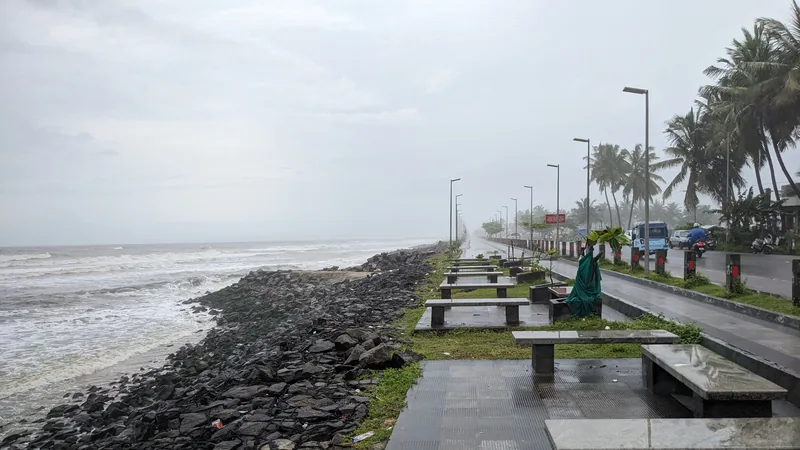
The rainfall test, after 10 May, is the one most often half-remembered. If 60% of the available 14 enlisted stations “report rainfall of 2.5 mm or more for two consecutive days, the onset over Kerala be declared on the 2nd day, provided the following criteria are also in concurrence.” [source] The fourteen stations on the criteria page are Minicoy, Amini, Thiruvananthapuram, Punalur, Kollam, Allapuzha, Kottayam, Kochi, Thrissur, Kozhikode, Thalassery, Kannur, Kudulu and Mangalore. [source] FAQ question 34 lists the same fourteen, but spells the thirteenth station Kasargode. [source] Kozhikode is on that list, and it is also the beach in Vinayaraj’s 25 July 2023 photograph. The photograph is not a station reading.
The wind-field test is more particular than a gust at the coast. “Depth of westerlies should be maintained upto 600 hPa, in the box equator to Lat. 10ºN and Long. 55ºE to 80ºE.” “The zonal wind speed over the area bounded by Lat. 5-10ºN, Long. 70-80ºE should be of the order of 15 – 20 Kts. at 925 hPa.” The source “can be RSMC wind analysis/satellite derived winds.” [source] The OLR test then uses a third official box: “INSAT derived OLR value should be below 200 wm-2 in the box confined by Lat. 5-10ºN and Long. 70-75ºE.” [source] Those three boxes are not the same official geography, and this desk does not redraw them.
On 4 June 2026, IMD reported lower-level westerlies of about 20–25 knots among the features associated with the declaration. [source] That observed figure is kept as an observed figure. It is not treated as a rewrite of the “15 – 20 Kts.” criterion. The 2026 season page holds the declaration in full official company, including a forecast that had pointed to 26 May.
Enjoyed this desk of official onset dates, three Kerala tests, and two official Julys?
No pop-ups. No intrusive advertising. Just interesting stuff. A little support helps the next climates.im site get built.